
Spring walk, hard truths
A reckoning about privilege, choices and the uneven burden of sustainability.
Dr Sourav Roy. 6th May 2026
I was passing through a neighbourhood on a slow Saturday morning, the kind of spring day in the UK that makes you forgive the drizzle because the air smells of cut grass and wet earth and the blossom is doing its best to look like a promise. I had nowhere urgent to be. The sun was polite, the sky a pale, forgiving grey, and the street hummed with small, ordinary sounds: a distant lawnmower, a radio playing something tinny through an upstairs window, the occasional bark of a dog that sounded more like a punctuation mark than a complaint. I was thinking about nothing and everything at once, which is to say I was thinking about the state of things.
Inside me there had been a debate for weeks, a private argument that kept returning like a song you can’t quite place. On one side was impatience and a kind of moral clarity: if we know what needs to be done for the planet, why aren’t we doing it? Why the delay, the half-measures, the polite compromises that leave the problem intact? On the other side was a softer, more complicated voice that kept reminding me of constraints—economic, social, structural—that make choices feel less like choices and more like survival. Is it laziness? Is it lack of awareness? Is it that people simply do not have the means to act differently? Or is it that the systems we live in quietly nudge us toward the easiest option, even when the easiest option is the worst for the future?
I had been turning that argument over in my head as I walked, and then I saw the sign.
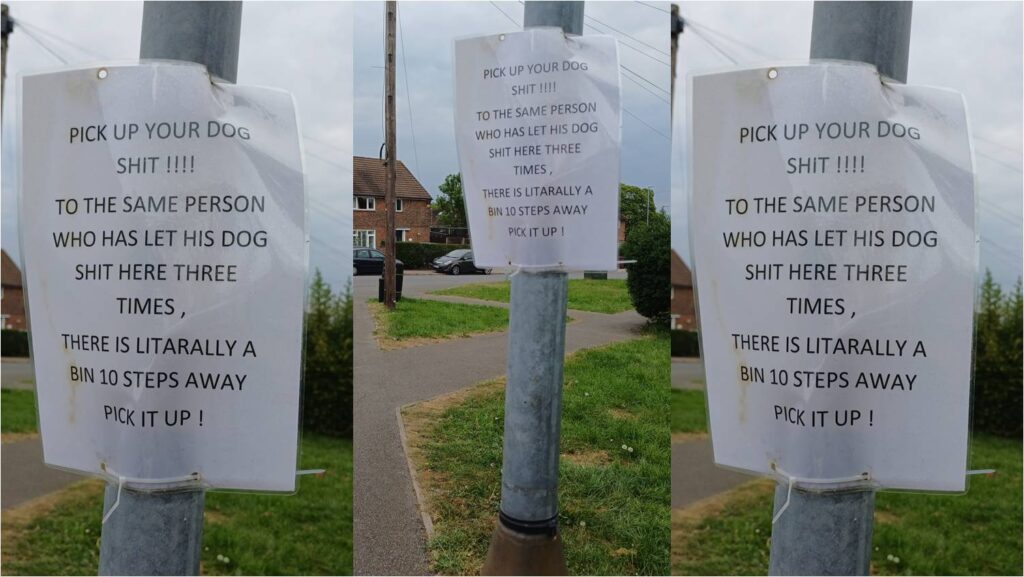
It was attached to a lamppost, printed on ordinary paper, taped and laminated as if the person who made it expected rain and wanted their message to survive it. The language was blunt, the tone exasperated, the kind of public admonition that reads like a neighbour’s voice raised in the street. The notice called out a dog owner for leaving mess where people walk, and it pointed out, with a kind of weary incredulity, that there was a bin ten steps away. The paper was weathered at the edges, the tape slightly cloudy, and behind the pole, if you stepped back and let your eyes widen, you could see the bin itself, small and ordinary, almost apologetic in the background.
Seeing that sign felt like a mirror. It reflected my internal debate in miniature. Here was someone who had noticed a problem, who had taken time to print, laminate, and attach a notice to a pole. That person had chosen to act in a small, local way. They had not waited for a council policy or a national campaign. They had not written a long letter or started a petition. They had done something immediate and visible. At the same time, the sign also revealed the limits of that action. A laminated notice can shame, can nudge, can make a passerby feel guilty for a moment, but it cannot change the structures that make irresponsible behaviour easy. It cannot, on its own, fund more bins, redesign public spaces, or alter the habits of people who are rushed, distracted, or simply indifferent.</p>
When I looked closer I noticed the care in the act. Laminating the paper suggested someone thought the message deserved to last. Tying it to the pole with tape or a zip tie suggested they expected it to be there for a while. That small investment of time and materials felt like a tiny act of stewardship. It was thoughtful, responsible, and quietly hopeful. It said: I care enough to do this. More of that, I thought, would be useful. Even if, as I passed, someone might smirk and mutter “oh whatever” and keep walking, the presence of the sign was a counterweight to indifference.
There is a famous line I kept hearing in my head as I stood there, looking at the lamppost and the bin behind it. “We are the ones we’ve been waiting for.” It is a line by June Jordan, a late American poet, essayist, teacher and activist, whose work on civil rights, feminism and social justice urged ordinary people to claim responsibility for change. The quote felt apt and slightly inconvenient. It reminded me that small acts matter, that they can ripple outward, and that the person who printed and laminated that notice had, in their own way, joined a long line of people who refused to accept the status quo.
But the sign also made me think about scale. A laminated notice addresses a local nuisance; it does not address the global systems that make sustainability a political and economic challenge. The gap between individual action and systemic change is where most of my internal debate lives. We can applaud the person who took the trouble to make a sign and we can also ask why more people do not feel empowered or enabled to take similar steps. Is it laziness? Sometimes. Is it lack of awareness? Sometimes. Is it lack of choice? Often. The truth is messy: habits, convenience, economic pressures, and institutional failures all conspire to make the sustainable option harder to choose.
As I walked on, the street offered other small scenes that felt like footnotes to the same story. A row of houses with solar panels on one roof and a gas boiler flue on the next. A car idling while someone ran inside to fetch a parcel. A garden with a compost bin tucked behind a hedge, and across the road a wheelie bin overflowing with single-use packaging. The smells shifted—cut grass, frying oil from a café, the faint chemical tang of a nearby car wash—and each scent seemed to carry a question about priorities and trade-offs. The sounds layered: a child’s laughter, the clack of a cyclist’s gears, the distant thrum of a delivery van. These ordinary details made the larger problem feel less abstract. Sustainability is not only policy and protest; it is the sum of tiny choices made every day.
I do not want to romanticise the laminated sign. It is not a solution to climate change or to global inequality. But it is a symptom of something important: the willingness of an individual to act, to make visible their expectation of communal standards. That willingness is a resource. It is not enough on its own, but without it, the scaffolding for larger change is weaker. If more people took small, visible steps—if more neighbours cared enough to laminate a notice, to pick up after their dog, to plant a tree, to write to their councillor—those acts could aggregate into pressure for systemic reform.
And here is the uncomfortable truth I want to leave with: many people in the Global North have a range of choices that others do not. We can choose our pensions, lobby our governments, change jobs, alter consumption patterns, and reduce travel in ways that are often luxuries rather than necessities. In many parts of the Global South, choices are constrained by manufactured poverty, debt traps, and economic structures that limit agency. That is not a moral failing of individuals; it is a political and economic reality. When I point out the laminated sign and the bin ten steps away, I am not saying that everyone in my neighbourhood is blameless or that small acts are sufficient. I am saying that where we have choices, we have responsibilities, and those responsibilities are heavier for those of us who can afford them.
So if you find yourself reading this and feeling a smirk rise—“oh whatever,” you might think—remember the person who printed and laminated that notice. Remember the small, deliberate act of someone who decided to try. It is easy to dismiss such gestures as performative or futile. It is harder to be the person who takes the trouble. We need more of those people, and we need systems that make their efforts matter. We need policies that turn individual goodwill into collective progress. We need to recognise that the capacity to act is unevenly distributed across the world, and that those of us with more options bear a greater share of the responsibility.
On that spring walk, with blossom in the gutters and a bin ten steps away behind a pole, I felt both the frustration and the possibility. The sign was a small, imperfect answer to a much larger question. It was a reminder that action can begin with a single, thoughtful person, and that the rest of us can choose, if we will, to follow.
Also available on:
https://drroys.substack.com/
https://www.linkedin.com/pulse/spring-walk-hard-truths-dr-sourav-roy-xmlie